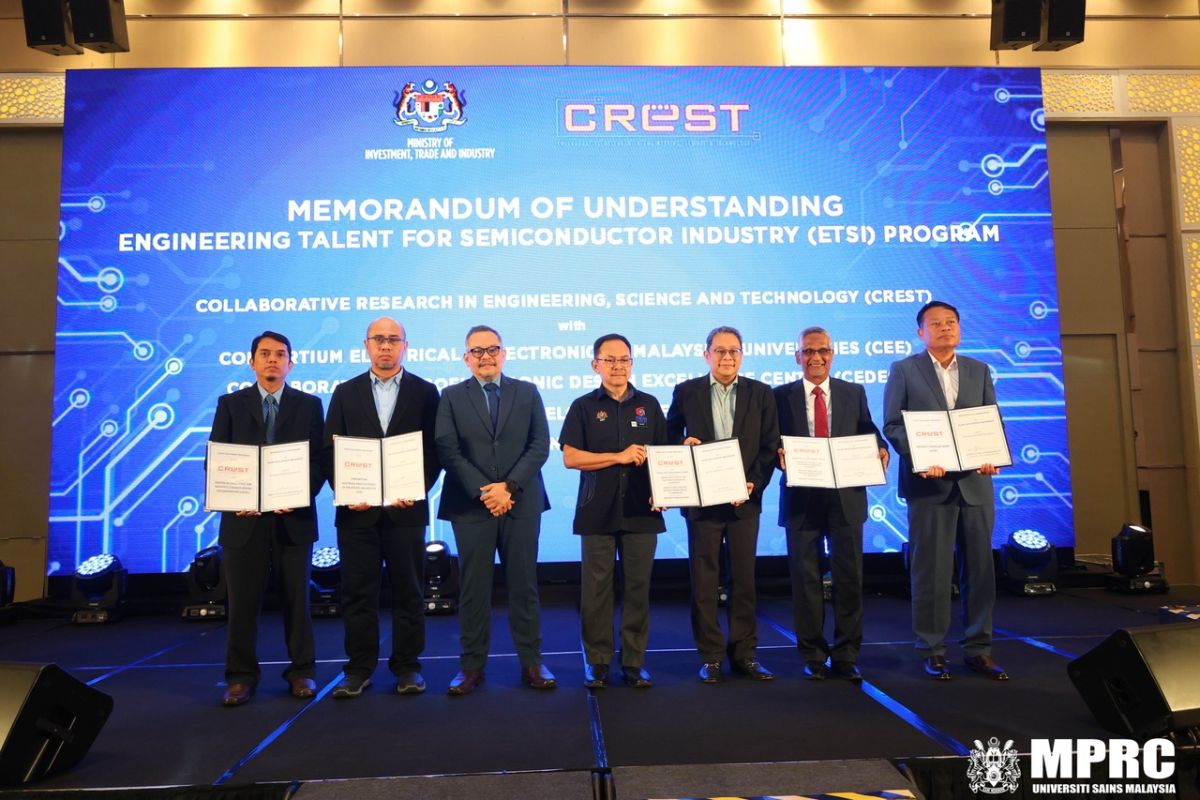
🚀 Penang’s Engineering, Science & Technology Research Centre: A “Technology Accelerator” for SMEs?
Many people know Penang as the “Silicon Valley of the East”, but they may not have heard of one important organisation supporting its technology ecosystem—CREST, which stands for Collaborative Research in Engineering, Science & Technology.
After learning more about CREST, I realised that it is more than an ordinary research centre. It acts as a bridge connecting:
🏭 Technology and manufacturing companies
🎓 Universities and researchers
🏛️ GOV agencies and R&D funding programmes
Established in 2012, CREST is currently an agency under Malaysia’s Ministry of Investment, Trade and Industry (MITI). It promotes collaborative research among companies, universities and the GOV.
In simple terms:
When companies face technical challenges or have innovative ideas, CREST can connect them with university researchers, engineering talent, testing facilities and suitable R&D resources—helping turn ideas into real products. 💡
What Does CREST Do?
🔬 Industry–university R&D collaboration
Companies present real industrial problems, while university researchers contribute their knowledge and technology to develop practical solutions.
💰 R&D and innovation funding
When applications are open, eligible projects may apply for matching funding to support applied research, MVPs, prototypes and new technology development.
👨🔬 Researcher and university matching
Instead of searching for suitable professors or laboratories independently, SMEs can work with CREST to identify relevant universities and research teams.
⚙️ Bringing technology to market
The aim is not merely to publish academic papers, but to apply research to factories, products and real market needs.
🎓 Developing engineering and semiconductor talent
CREST supports internships, training and research programmes that help produce engineers with industry-relevant capabilities.
🤝 Connecting the technology ecosystem
It helps SMEs connect with universities, multinational companies, GOV agencies and other technology partners.
Why Do SMEs Need CREST?
Many SMEs have good ideas but face practical limitations:
❌ No dedicated R&D department
❌ Difficulty employing specialised technical talent
❌ Limited access to costly testing facilities
❌ Uncertainty about which university to approach
❌ High development costs and technical risks
❌ Great ideas but no working prototype
CREST helps SMEs reduce these barriers.
For example, imagine a Penang SME that manufactures automated inspection equipment. Its customer requests an AI system capable of identifying microscopic product defects.
The SME understands its machines and customers but lacks computer-vision expertise. CREST may be able to help it:
✅ Identify a suitable university research team
✅ Structure an industry-driven R&D project
✅ Apply for an appropriate R&D funding programme
✅ Develop and test a prototype
✅ Train the company’s engineers
✅ Create patents or intellectual property
✅ Prepare the technology for commercial use
However, the SME must still contribute resources, employees, technical information and time. CREST acts as a facilitator and collaborator—it does not take over the entire project.
Which Technology Areas Does CREST Support?
CREST’s focus areas include:
🔹 IC design, testing and validation
🔹 IoT and embedded systems
🔹 LED and optoelectronics
🔹 Advanced materials and semiconductor packaging
🔹 Industry 4.0 and smart manufacturing
🔹 Drones and autonomous vehicles
🔹 Digital healthcare
🔹 Smart cities
🔹 Precision agriculture
Real Example: From a Three-Person Team to the Global Market 🌏
Malaysian IC-design company Oppstar Technology began as a small three-person start-up.
During its early stage, the company operated from CREST’s collaboration space and received mentorship, industry connections and research support. Oppstar later grew into a Malaysian IC-design company serving the global market.
This shows that CREST may offer more than funding:
🏢 Incubation and collaboration space
🤝 Industry connections
🎓 University research collaboration
🧭 Technical and commercial guidance
💻 Access to the semiconductor ecosystem
Another example involved Motorola Solutions and Universiti Sains Malaysia. They collaborated to improve wind-noise performance in compact two-way communication devices.
The project resulted in a US patent, and the technology was subsequently incorporated into a product platform for the global market. 📡
Is CREST Suitable for Every SME?
Not necessarily. CREST is more relevant to companies that:
✅ Face genuine technical challenges
✅ Want to develop innovative products or processes
✅ Have clear market demand
✅ Are willing to collaborate with universities
✅ Can contribute resources, staff and time
✅ Plan to commercialise the results
If a company only needs ordinary financing, marketing assistance, working capital or off-the-shelf software, CREST may not be the most suitable platform.
In my view, CREST’s greatest value is helping Malaysian SMEs progress beyond simply manufacturing for others. It gives them an opportunity to:
✨ Design their own technology
✨ Own intellectual property
✨ Develop higher-value products
✨ Enter global technology supply chains
-
CREST’s R&D funding is normally subject to application and evaluation—it is not automatically awarded. Funding amounts, technology areas and eligibility requirements may also change, so companies should refer to CREST’s latest announcements.
If your company is facing a technical challenge or has an innovative idea but does not know how to bring it to life, CREST could be a platform worth exploring! 🚀
What do you think Malaysian SMEs lack most—resources, talent or technology? Leave your thoughts below! If you found this useful, remember to like ❤️, save ⭐ and share it with others!
#Malaysia #Penang #CREST #SME #TechnologyInnovation #Semiconductor #Industry40 #SmartManufacturing #ResearchAndDevelopment #PenangIndustry #SiliconValleyOfTheEast #Entrepreneurship